What a wind hold actually is
The line stopped for four hours on Thursday. Here is the number it stopped on, who read it, and why we would rather publish the threshold than the apology.
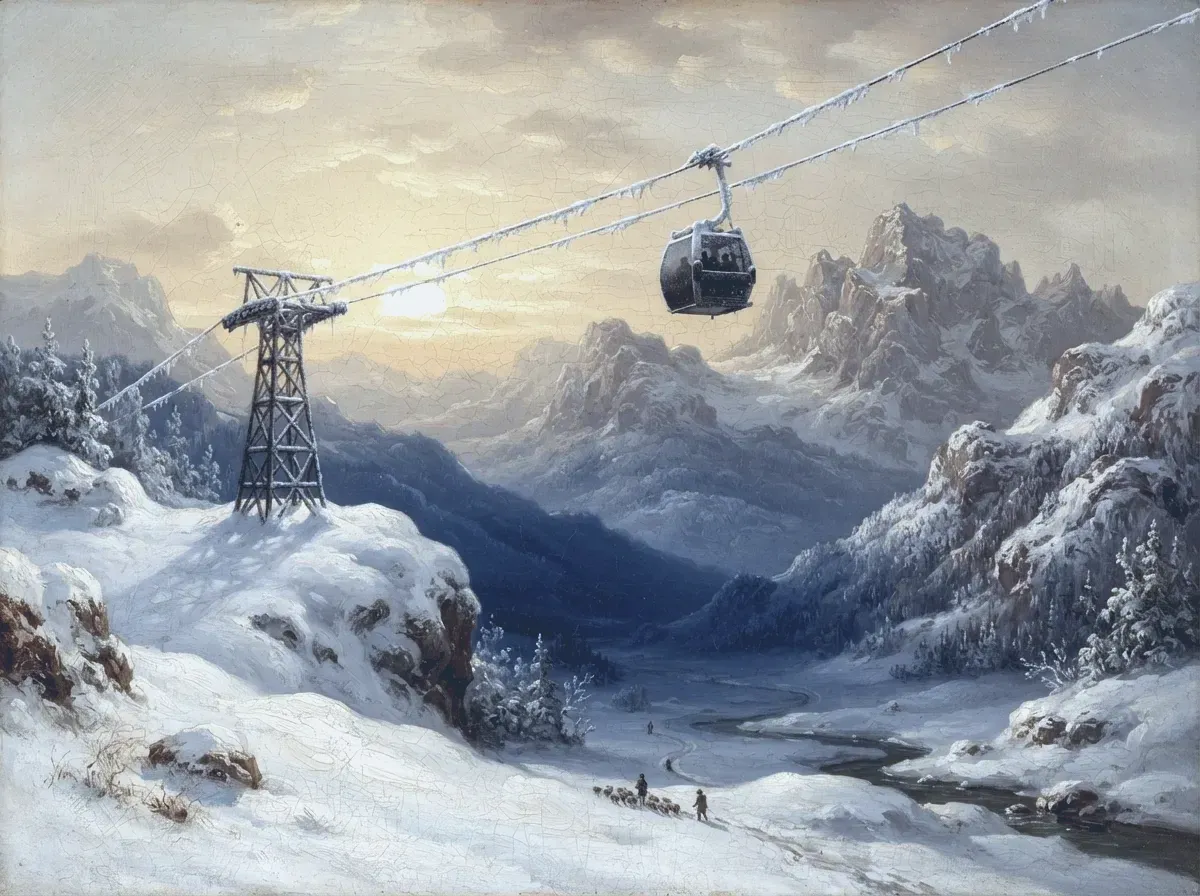
The line stopped at 11:42 on Thursday and did not carry a passenger again until 15:50. Around two hundred people were turned back at the barrier in bay 2 and every unused ascent was refunded there and then. This is the entry that explains what happened, because a cableway that only publishes its good days is not publishing anything.
The number it stopped on
Tower IV carries the anemometer. It is the exposed tower — the saddle above it funnels, and in the same weather it reads three to five metres per second above the base station. At 11:41 it recorded a sustained 22.4 m/s over the two-minute mean. The threshold is 22.
The question the crew asks
Is the rope safe, or is the ride safe? They are not the same question, and only one of them has a number on it.
The rope was never in question. A 46 mm full-locked haul rope is not troubled by 22 m/s. What a cross-wind does is push the cars off the vertical, and a car that is swinging enough will not enter the station cleanly — the grip has to open against a moving hanger, at 0.3 m/s, with people standing at the door.
The failure we are avoiding
Not the rope. The station.
Almost every serious incident on a detachable monocable happens in the terminal, in the few seconds when the grip is off the rope and the car is running on tyres. Wind decides whether those seconds are ordinary or interesting.
Who reads the number
Machine room, Talstation
The hold sequence, in the order it runs
- The anemometer feeds the drive controller directly. At the two-minute mean over threshold the controller raises an alarm; it does not stop the line by itself.
- The duty driver confirms the reading against the second head on the top station and against the state of the cars on the line.
- The line runs in. Cars are driven to the nearest station at reduced speed and parked; nobody is left on the rope.
- The barrier closes and the board changes. Sales stop before the cars do.
- The hold is logged with the reading, the time and the driver’s name. That log is what the annual audit reads.
What we do not do We do not run “one more car” to clear a queue, and we do not restart on a lull. The restart is on the same two-minute mean, from below, for ten consecutive minutes.
Why the threshold is published
An operator can hold the number private and tell you the line is closed for safety. That sentence cannot be checked, and it covers everything from a gale to a driver who wanted an early finish. A published threshold can be checked — by you, on the day, against any weather station you like.
Standing practice
Every threshold that stops this line is on the safety page, with the action attached to it. If we ever hold on something that is not on that list, the entry that explains it will say so in the first line.
If you are standing at the barrier
What you are entitled to, without asking
- The current reading at Tower IV, from the board or from the staff.
- A full refund on an unused ascent, at the barrier, in the way you paid.
- A free descent if you went up on our rope before the hold.
- The expected review time — we re-read at fifteen-minute intervals and say so.
What Thursday cost
Four hours and eight minutes is 0.4 % of the winter’s scheduled hours. The season figure will land somewhere near 99.4 % again, which is the number on the safety page, and it is a number that only means anything because the hours we did not run are in it.
Next haul
The thresholds, in full, with what happens at each
Five measurements, five numbers, five actions. Nothing on that page is a judgement call made in the machine room.
Sources
- Vordergrat Seilbahn drive-controller log, sheet 4,118 (invented).
- Tower IV anemometer, two-minute mean, 11:30 — 16:10 (invented).
- Annual rope scan report, autumn overhaul (invented).